

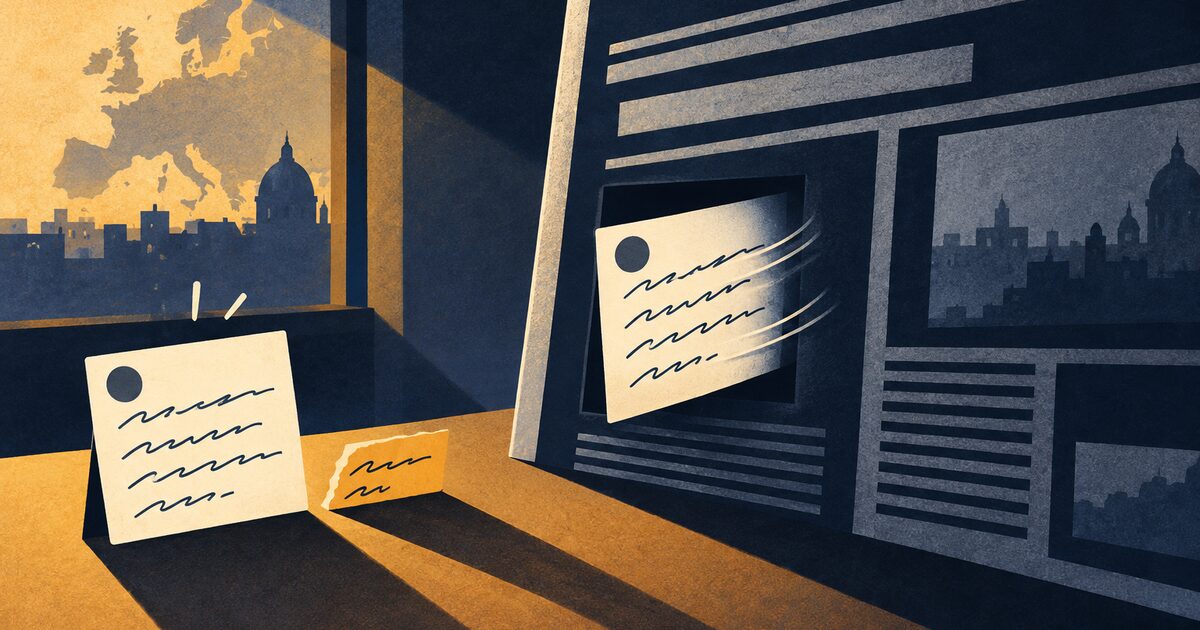
A teacher posted 22 lines on Facebook. An online newspaper copied the entire text. The Court of Justice of the European Union explained when a short text can be a protected work and how far the news reporting exception may go.
Yes, a short social media post can be protected by copyright if it expresses its author’s creative choices. And reporting on the post does not automatically entitle a news outlet to reproduce it in full. That is the central point of the Gândul Media judgment, Case C-598/24, delivered on 3 September 2026. The ruling interprets European Union law; in Argentina, a similar dispute must be assessed under Copyright Law 11,723.
Key point. The length of a post does not, by itself, determine whether it is protected. Nor do crediting the author and adding a link automatically justify any amount of copying. The questions are whether the text contains original expression, how much was copied, and which specific exception might apply.
What happened in Gândul Media?
A Romanian teacher published a 22-line Facebook post at the beginning of the school year. She explained to parents why she did not want to receive gifts from her pupils’ families. Days later, a journalist reproduced her entire text on a newspaper website without first seeking permission. The newspaper added her name and a link to the original post afterwards. The teacher brought a claim for an alleged infringement of her copyright.
The lower courts dismissed her claim because they considered that the post was not a protected work. On a reference from Romania’s highest court, the Court of Justice of the European Union (CJEU) addressed two legal questions: whether such a text can qualify as a work, and how much discretion a Member State has when implementing the exception for reporting current events. The CJEU did not finally decide whether an infringement occurred. It left the necessary factual assessments to the Romanian court.
A short post can be a copyrighted work
Under the CJEU’s approach, protection requires two elements: the author’s own intellectual creation and an identifiable expression of that creation. Originality can lie in the selection, arrangement and combination of words. It does not depend on the text being long, appearing in a book, or belonging to a formal literary genre. The judgment also explains that a text may fail the test if rules or constraints left its author no room for free creative choices.
This does not make every tweet, caption or everyday message a copyrighted work. A purely functional or commonplace sentence may lack the required originality. As to this teacher’s post, the CJEU identified indications of free and creative choices, but held that the national court must determine whether the text actually meets the conditions for protection.
The distinction also matters to people who publish professional content: copyright protects the original way in which you express an idea, not the underlying idea, fact or opinion in the abstract. Someone can report that a teacher declined gifts without necessarily appropriating the 22 lines in which she explained her reasons.
Reporting a story is not the same as copying everything
Article 5(3)(c) of EU Directive 2001/29 allows Member States to provide an exception for using works in connection with reporting current events, to the extent justified by the informatory purpose and with acknowledgement of the source and author where possible. The CJEU said that the school issue discussed in the post could be of public interest at that time. A news report need not include an extensive analysis or invite public debate to fall within the concept. Whether the event qualifies in this dispute remains for the Romanian court.
Romania limited that exception to short extracts. The CJEU found that a limit of this kind is permissible if it is proportionate and preserves the purpose of the exception. A news article may explain the event and quote what is needed; reproducing an entire work may replace the original communication, removing any reason for readers to consult it. The judgment acknowledges a difficult case where a text is so short that it cannot sensibly be used in extracts. Its application still calls for an assessment of the circumstances and the balance of rights.
The other Romanian restriction produced a different result. It barred any direct or indirect commercial or economic benefit from the reproduction. The CJEU rejected that as a general condition: the Directive does not impose it, and news organisations normally carry out economic activity to sustain their reporting. A newspaper’s commercial activity alone does not prevent it from relying on the EU news reporting exception; equally, it does not give it unlimited permission to copy works.
What does this mean for creators and publishers in Argentina?
The European judgment is useful when thinking about digital content, but it does not apply directly in Argentina. Argentine Copyright Law 11,723 includes writings of every nature and length among potentially protected works. It protects the expression of ideas and gives authors, among other rights, control over reproduction. Neither brevity nor publication on Facebook automatically excludes protection under Argentine law. The text’s originality and the circumstances of its use must be assessed in each case.
The EU exception cannot simply be imported into Argentine law. Section 10 of Law 11,723 governs certain uses for educational or scientific purposes, comments, criticism or notes, and requires the use to be limited to indispensable portions, subject to its conditions. Its reference to one thousand words is not a general licence to copy entire social media posts. Acknowledging the author and source matters, but attribution alone does not replace permission when permission is legally required.
For example, suppose an agency wants to report that a designer published an original 15-line manifesto about her work. It could describe the news in its own words, link to the post, and assess whether a short quotation is necessary for its commentary. Copying all 15 lines on the agency’s own website raises a different question: is there a licence, permission or applicable exception? The fact that the agency’s website carries advertising does not settle the matter either way.
The same caution helps distinguish different forms of online use. Copying the full text onto your own server does not pose precisely the same issues as linking to it or displaying content from its original platform. Our article on embedding and copyright discusses that distinction. Our analysis of upcycling and the reuse of protected works explains why changing or reusing someone else’s content also calls for a rights review.
What should you do before republishing someone else’s post?
First, ask whether you genuinely need the entire text to report the story, or whether you can summarise the event and link to the source. Second, identify the author, the original publication and any platform terms or licence. Third, if the post contains clearly original expression and you want to reproduce a substantial part of it, seek permission or obtain legal advice on whether a specific exception applies. Keep a record of the permission and the version you publish.
If you created the text and found a copy, preserve dated screenshots, URLs and context. Check how much was reproduced and whether you were credited. You can then consider a takedown request, a licence negotiation or a claim, depending on the facts. Our intellectual property practice for creators and businesses helps clients make those decisions, from protecting a work to addressing third-party use.
Frequently asked questions
Is every social media post protected by copyright? No. Posting online does not prevent protection, but the text must satisfy the relevant originality standard. Facts and ideas alone are not owned through copyright.
Can I copy a post if I name its author? Attribution is important, but it does not, by itself, authorise reproduction of the full text.
Can a newspaper publish the entire post because it is news? In the EU, the informatory purpose, the proportion used and the applicable national exception must be assessed. In Argentina, the analysis depends on Law 11,723 and the particular facts.
Does Gândul Media bind Argentine courts? No. It is European case law that may offer comparative reasoning. An Argentine dispute is decided under Argentine law and the facts established in the case.

Emiliano Sebastián Herrera
Emiliano Sebastián Herrera is co-founder of Herrera & Flamenco Abogados and works on intellectual property matters, including trademarks, copyright and emerging technologies, with a particular focus on protecting intangible assets and using these tools strategically in businesses and creative projects.
Has someone used your content without permission?
Tell us what was published, where it appeared and what you would like to resolve. We can review the use and advise you on the next steps.
Ask us about your content
Send us your basic contact details and a short description of the use that concerns you.
Herrera & Flamenco Abogados · Córdoba, Argentina
1 Comment