

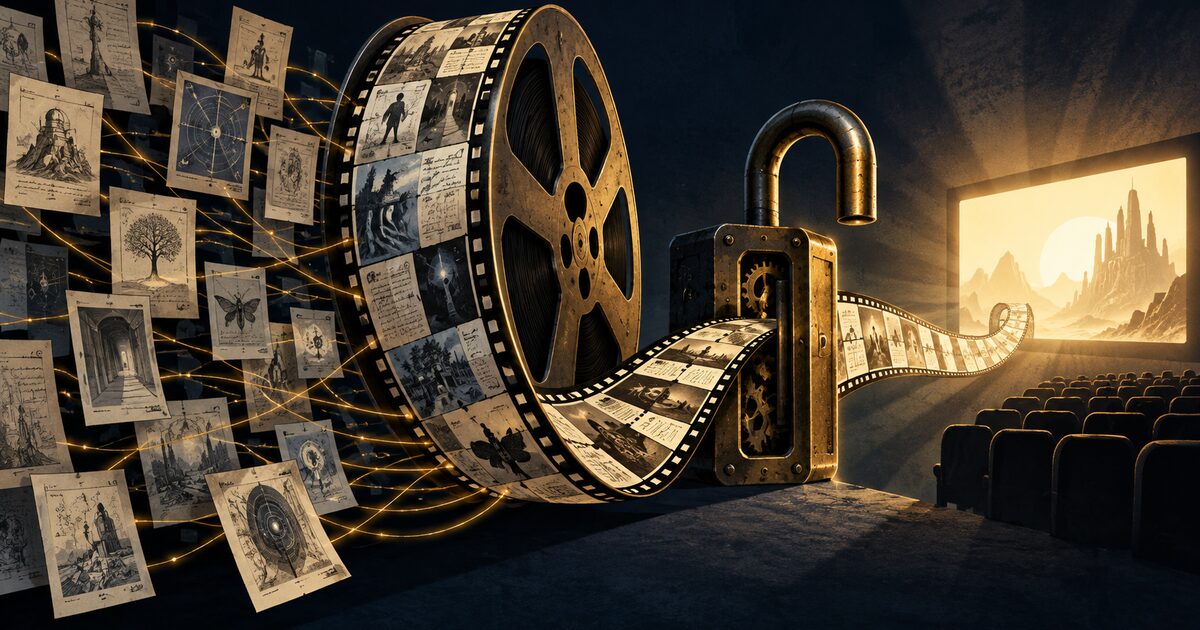
An announced SCP film shows how an open license can permit a commercial production while making the exclusivity expected by studios and distributors much harder to secure.
A24 can participate in an SCP-related film, charge for tickets and distribute it commercially, but that does not necessarily give the company exclusive control over the underlying universe. The legal outcome turns on an earlier question: does the film adapt protected expression from identifiable SCP articles, or does it merely use general ideas—a secret organization, unexplained anomalies and clinical-looking reports—that copyright does not protect?
Key point: an open license is not the public domain. It authorizes specified uses subject to conditions. Before incorporating third-party material into a product, a business must identify the exact license, the material being used and whether the resulting obligations fit its distribution model.
What is SCP, and where does A24 fit?
SCP Foundation is a collaborative horror-fiction project created online. Thousands of contributors write stories about a fictional secret organization that secures, contains and studies anomalous objects, beings and events. Many entries are presented as technical files with classifications, containment procedures, observations and appendices. There is no single novel and no single author who created the entire body of work.
The proposed film V/H/S: SCP, currently expected in 2027, connects that setting with the found-footage anthology franchise V/H/S. Spooky Pictures and Image Nation are behind the project, while A24 joined as distributor. According to reporting on the announcement and the community’s response, the SCP Wiki team had not been consulted and the public still does not know which specific articles, characters or anomalies the screenplay will use.
That missing information matters. A title and a marketing concept may suggest a close relationship with SCP, but copyright scope is determined by comparing the material actually used—not by deciding who won the first public statement.
What CC BY-SA allows
SCP content is generally released under Creative Commons Attribution-ShareAlike 3.0 Unported, usually shortened to CC BY-SA 3.0. The license permits copying, distribution, public performance and adaptation, including for commercial purposes. A film, game, book or piece of merchandise may be sold. Creative Commons does not mean “ownerless,” “copyright-free” or “non-commercial.”
Two conditions do most of the work. Attribution requires appropriate credit for the author and the source. ShareAlike requires a distributed adaptation to be offered under the same license or another license permitted by its compatibility rules. The CC BY-SA 3.0 legal code also prevents a licensee from adding terms that stop recipients from exercising the granted rights.
The commercial consequence is easy to miss. A producer may charge for a CC BY-SA film, but recipients may be able to copy it, redistribute it and create further adaptations—even commercially—if they comply with attribution and ShareAlike. The license protects freedom to reuse, not a promise of zero price.
The threshold issue: inspiration or derivative work?
ShareAlike is not triggered by thematic similarity alone. Copyright protects original expression, not a general premise. A shadow organization that contains paranormal threats, a bureaucratic tone, an archival visual language or the basic format of a scientific report may operate as ideas, methods or genre conventions that no author can monopolize by themselves.
If the screenplay invents its own anomalies, characters, incidents and dialogue, the filmmakers may have a credible argument that they created an independent work inspired by a genre or premise. Detective stories can share detectives; space adventures can share expeditions; horror films can share government files. Copyright does not give the first user ownership of every later expression of an idea.
The analysis changes if the film uses a particular creature, its history, its containment rules, a narrative sequence or characters developed in an identifiable article. Translating that literary expression into moving images may be a classic cinematic adaptation. The SCP licensing guide says that a project using a particular SCP entry or tale should identify both the article and its individual author.
Between those positions lies the difficult category: ideas developed cumulatively by many writers, elements repeated across different canons and combinations that have become part of SCP’s recognizable narrative identity. A serious analysis would have to reconstruct who contributed what and separate protectable expression from shared concepts.
Drauglis: using a licensed work does not always license the whole product
A useful precedent is Drauglis v. Kappa Map Group, decided in 2015 by the U.S. District Court for the District of Columbia. A publisher placed a Flickr photograph licensed under CC BY-SA 2.0 on the cover of a commercial street atlas. The photographer argued that the entire atlas should have been made available under ShareAlike terms.
The court disagreed. The photograph had been included essentially intact alongside independently created maps. The atlas was treated as a collective work rather than a derivative work based on the photograph, so ShareAlike did not extend to the atlas as a whole. On the facts of that case, the “CC BY-SA 2.0” reference and back-cover credit also satisfied the license requirements.
The decision establishes an important limit: ShareAlike does not automatically “infect” everything placed next to licensed material. But it does not resolve the SCP film question. Using an unaltered photograph as cover art is not the same as dramatizing a story. The case also interpreted version 2.0, while SCP uses 3.0. The later license maintains a comparable distinction between a Collection and an Adaptation, but its own language controls.
An anthology film could even produce segment-by-segment answers. One short might adapt a specific article under CC BY-SA while another tells an entirely original story. Identifiability and separability would then become central to defining how far ShareAlike reaches.
DRM and commercial exclusivity
CC BY-SA 3.0 prohibits effective technological measures that prevent recipients from exercising the licensed rights. If a film must be distributed under that license, a system that permits viewing while technologically preventing every copy or redistribution may conflict with the license. This creates obvious tension with streaming DRM, encrypted theatrical files and digital-rental platforms.
But “no DRM” does not make every act lawful. Creative Commons explains that not every access restriction is a prohibited technological measure. Requiring a password or limiting the initial group of recipients does not necessarily prevent those recipients from exercising their licensed rights later. The license also does not automatically turn a clandestine recording inside a cinema into a lawfully received copy.
The careful conclusion is narrower: if the film is an adaptation governed by CC BY-SA, exclusive distribution and some DRM structures face a serious compatibility problem. There is no reported judgment applying this clause to an international theatrical production on this scale.
Thousands of authors and moral rights
Speaking about “SCP’s rights” can conceal the ownership problem. The wiki is a collaborative collection, while individual writers retain rights in their contributions. Protection for the selection or arrangement of a collection does not erase copyright in each article. The Berne Convention recognizes that separation and protects an author’s right to claim authorship and object to distortions or other derogatory treatment prejudicial to honor or reputation.
“Unported” does not mean that U.S. law governs every contributor. Authors in Europe, Latin America and elsewhere can use the same CC BY-SA 3.0 license, while moral rights and remedies may differ in the country where protection is claimed. The international enforcement question resembles the territorial problems that also arise in cross-border intellectual property disputes: identifying the right is only part of the analysis; forum and applicable law matter too.
The license itself requires attribution—using a supplied real name or pseudonym—and prohibits implying that an author endorses or sponsors the adaptation. It also addresses derogatory modifications, subject to a waiver or non-assertion only to the extent legally permitted and necessary to allow reasonable adaptations.
Not every unwanted change supports a moral-rights claim. A claimant would need to identify the article, show what protected expression was taken and explain which credit was omitted or how the treatment harmed reputation under the applicable law. That is difficult in a universe built by thousands of people. Yet the same fragmentation creates a chain-of-title problem for a producer: general approval from wiki administrators may not replace permission or compliance owed to each relevant author.
Copyright, trademarks and standing are separate questions
Creative Commons licenses deal primarily with copyright. They do not automatically grant trademark rights. Permission to adapt wiki content does not by itself decide who may use “SCP Foundation” as a badge of commercial origin, register a logo or market a film as officially connected with a particular organization. That requires a separate inquiry into registrations, use, ownership and likely confusion.
This distinction is the same reason a copyright license does not replace a trademark analysis for an ordinary business. Our explanation of trademarks, trade names and domain names in Argentina illustrates how different rights can coexist around the same words or visual identity without becoming interchangeable.
Standing to sue also depends on the right asserted. If the film copies one article, that article’s author or copyright owner is the natural claimant. A logo, compilation or separately managed element may have a different owner. The SCP team says it has authority to perform certain enforcement functions, but that does not automatically make the wiki the sole owner of every story.
What businesses and creators should check
Imagine a producer combining a Creative Commons photograph, music under another public license and text taken from an open collaborative project. The finished campaign may be commercially valuable, but each component brings its own conditions. An incompatible license can defeat expected exclusivity, require multiple credits or force an adaptation to circulate on terms that conflict with a streaming, publishing or investment agreement.
Before release, identify the exact license version; preserve evidence of source and authorship; distinguish an intact inclusion from an adaptation; check attribution and ShareAlike; examine DRM and distribution contracts; separate copyright from trademark, image and privacy rights; and confirm who controls each component. Do this before promising exclusivity to investors or distributors.
The SCP controversy shows the cost of reviewing licenses late. An open license can support a profitable project. What it may not support is an exclusive business model built after the public has already received irrevocable reuse rights.
Frequently asked questions
Does Creative Commons mean a work must be free of charge? No. Many CC licenses permit commercial use and charging for copies or access. The conditions govern reuse; they do not necessarily set a zero price.
Must every SCP-inspired film use CC BY-SA? Not necessarily. The answer depends on whether it adapts protected expression from identifiable works or uses only unprotectable ideas and conventions.
Does ShareAlike require delivery of all raw production files? Not by itself. It does not impose a zero price or require distribution of material that was never supplied. It does require preservation of the licensed freedoms in the adaptation that is distributed.
Can an individual SCP writer bring a claim? Potentially, if the writer can establish authorship or ownership and connect protected expression from that contribution to the film. Identifying and proving that use is the difficult part.
Does your project use open-licensed material?
We can review attribution, license compatibility, copyright and trademark issues before you release a product or promise exclusive rights.
Tell us about the material you want to use
Send your basic contact details and a short description of the work or license. We will contact you to review the project.
Herrera & Flamenco Abogados · Córdoba, Argentina